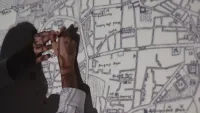
Garine Boghossian, These Ghostly Places We Call Home (still), 2026.
Existing Condition
part of
Thursday, October 12, 7-8:30pm
How can a map hold the memory of a place?
Garine Boghossian’s project An Armenian Atlas / Աշխարհացոյց works through maps drawn from memory by survivors of the Armenian Genocide and collected in houshamadyan memorial books. It is an ongoing effort to map, mourn, and reparatively reimagine the diasporic relationship with the lost Western Armenian homelands.
Over the past three years, Boghossian has traced and cataloged what has been lost and what persists, despite the century-long targeted urban destruction and transformation in formerly Armenian neighborhoods, towns, and villages across present-day Turkey. The hand-drawn memory maps, which serve as her key sources, represent not only the physical space of Ottoman Armenian life, but also record how that life was lived, remembered, and carried across generations.
She will present a selection of these maps alongside some of her own counter-mapping work, which overlays memory maps with contemporary satellite imagery, photography, and video. Her aim is to document urbacide, uncover the spectral remains of Western Armenian space, and imagine post-denialist futures.
The presentation will be followed by a screening of Boghossian’s video essay These Ghostly Places We Call Home (2026), which moves between the former Armenian quarters of Aintab and Urfa and the artist’s home studio in New York. Guided by the memories of former inhabitants, Boghossian walks through these cities, then returns to New York to redraw, remember, and embroider what she has encountered. The film’s visual collage is accompanied by memoir, poetry, and oral history in Western Armenian, Turkish, and English, read by Boghossian and her father.
The evening will close with a conversation between Boghossian and Joanne Randa Nucho, Associate Professor of Anthropology at the University of Southern California.
Garine Boghossian is an architect and urbanist based in New York with more than a decade of experience on large-scale design projects worldwide. She is the founder of An Armenian Atlas / Աշխարհացոյց, an ongoing research and mapping initiative exploring Western Armenian spatial histories and cartographies. A Visiting Critic in Architecture at Cornell University, she has also taught architecture and urban design at the New Jersey Institute of Technology, Northeastern University, and the Boston Architectural College. Her writing on the built environment and Armenian diasporic concerns has appeared in Line Files, Expansions, Broken Nature, The Funambulist, EVN Report, and Wasafiri, among other publications.
Joanne Randa Nucho is an anthropologist and filmmaker. She has written extensively on the politics of the built environment and the breakdown of public and collective grids in Lebanon and California. Filmed in and around a suburb of Beirut, Lebanon, her film The Narrow Streets of Bourj Hammoud (2018) features interviews with residents who use drawing to engage with the city as a palimpsest, uncovering layers of displacement and migration over the past century.