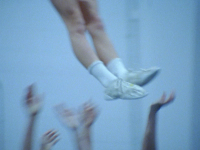
Still from Full Out, Sarah Ballard, 2025
Events for a Moving Body (Night II)
part of
Related Exhibitions
Events for a Moving Body
Screenings and Readings presented by JOAN, Rotations & Alexis Kyle Mitchell
January 31
at Now Instant Image Hall
939 Chung King Rd, LA, 90012
7pm, 119 min. (doors 6:30pm)
To purchase tickets see here
More information on Night I of the January 30 program
Films by Peter Weiss, Jacqui Duckworth, Julie Dash, Mary Helena Clark, Barbara Hammer, Sarah Ballard, Yelena Gluzman, Onyeka Igwe, Margaret Raspé, and Zora Neale Hurston
Readings by Danielle Carr, Amelia Bande, and Julie Tolentino
Curated together by Rotations’ Corina Copp, JOAN’s Suzy Halajian, and artist Alexis Kyle Mitchell, this two-night screening and reading program commemorates the final days of Mitchell’s exhibition The Goal of Our Health, on view at JOAN through January 31. Events for a Moving Body brings together films and readings that think with the body as a site of knowledge, relation, and struggle. Spanning archival and contemporary experimental, ethnographic, and transnational queer, feminist and artist cinema practices, these works reflect on athleticism, performance, hysteria, spirit, and human–animal ecologies; extending Mitchell’s inquiry into how embodied knowledge resists the limits imposed on bodies by medical, economic, social, and ideological structures.
Mitchell’s JOAN exhibition marks the Los Angeles premiere of her 2024 feature-length film The Treasury of Human Inheritance, which explores the idea of inheritance as a genetic, political, and spiritual set of relations; and includes newly commissioned works that unearth a history and aesthetics of fascist and eugenicist logics and practices. In dialogue, Events for a Moving Body constellates transtemporal moving images that bring into view the body in its sensorial labors—Jacqui Duckworth, Julie Dash, Peter Weiss, Margaret Raspé—with anachronistic works by artists Onyeka Igwe, Yelena Gluzman, Sarah Ballard, and Mary Helena Clark, among others, that immerse us newly.
How have bodies historically navigated constraint through collectivity, ritual, repetition, and shared forms of attention? Invited poets and scholars Danielle Carr, Amelia Bande, and others will read in and around the film-work, together proposing the body as something not merely acted upon. Instead, histories are embodied, memory flows multidirectionally, and new forms emerge for health, care, and desire outside capitalist and imperialist frameworks.
*
THE SADIST BEATS THE UNQUESTIONABLY INNOCENT
Margaret Raspé
1971, 6 min.
As early as 1971, Raspé developed the so-called ‘camera helmet’ before these were industrially available: a construction site helmet equipped with a Super 8 camera that captures the central perspective of the artist’s gaze and enabled her to film her everyday life. The resulting films show the artist performing routine tasks, including housework. The body is considered as a programmable ‘Mensch-Maschine’ (human machine) or as a ‘Frautomat’ (female robot), to which the camera helmet acts as a prosthetic extension and enables the viewer to experience the artist’s own perspective, universally mirrored. Of her work, Raspé wrote, “These films are cut-outs off the running thread of time of this spiral of life and death, growth and dissolution.”
INVISIBLE MACHINES
Yelena Gluzman
2025, 24 min.
Bringing together histories of feminized labour with ethnographic scenes of stenographers captioning for d/Deaf students in the classroom, this experimental film considers how captioners and their clients make sense of demands for invisibility, neutrality, and access. Formally, by interrupting the normative coherence of sound and image, the film reflexively undermines the fluency of its own audio track to make palpable the nuanced interpretive work that goes into transcribing across modalities.
NEIGHBORING ANIMALS
Mary Helena Clark
2024, 9 min.
Neighboring Animals is organized around the mouth – as a tool to bite and chew, as an instrument of speech, and as a site of disgust and desire. The film incorporates footage of animal dentistry, bite mark analysis, and a reliquary containing the tooth of Mary Magdalene, alongside text quoting from psychological studies on disgust, Georges Bataille, and Emily Dickinson, among others.
NO DANCE, NO PALAVER: SPECIALISED TECHNIQUE
Onyeka Igwe
2018, 7 min.
No Dance, No Palaver is a series of three works, all of which use the first major anti-colonial uprising in Nigeria as an entry point to experiment with colonial moving images relating to West Africa during the first half of the 20th century. In the third, Specialised Technique, William Sellers and the Colonial Film Unit developed a framework for colonial cinema. This included slow edits, no camera tricks and minimal camera movement. Hundreds of films were created in accordance to this rule set. In an effort to recuperate black dance from this colonial project, Specialised Technique attempts to transform this material from studied spectacle to livingness.
FOUR WOMEN
Julie Dash
1975, 7 min.
In Four Women, one of the first experimental films by a Black woman filmmaker, dancer Linda Martina Young interprets the same-titled ballad by Nina Simone and embodies the spirits of four women — Aunt Sarah, Saffronia, Sweet Thing and Peaches — who represent common stereotypes of Black women attempting to survive in America.