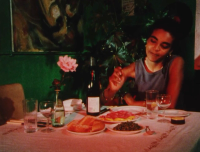
Still from A Prayer Before Birth, Jacqui Duckworth, 1991
Events for a Moving Body (Night I)
part of
Related Exhibitions
Events for a Moving Body
Screenings and Readings presented by JOAN, Rotations & Alexis Kyle Mitchell
January 30
at Now Instant Image Hall
939 Chung King Rd, LA, 90012
7pm, 84 min. (doors 6:30pm)
To purchase tickets see here
More information on Night II of the January 31 program
Films by Peter Weiss, Jacqui Duckworth, Julie Dash, Mary Helena Clark, Barbara Hammer, Sarah Ballard, Yelena Gluzman, Onyeka Igwe, Margaret Raspé, and Zora Neale Hurston
Readings by Danielle Carr, Amelia Bande, and Julie Tolentino
Curated together by Rotations’ Corina Copp, JOAN’s Suzy Halajian, and artist Alexis Kyle Mitchell, this two-night screening and reading program commemorates the final days of Mitchell’s exhibition The Goal of Our Health, on view at JOAN through January 31. Events for a Moving Body brings together films and readings that think with the body as a site of knowledge, relation, and struggle. Spanning archival and contemporary experimental, ethnographic, and transnational queer, feminist and artist cinema practices, these works reflect on athleticism, performance, hysteria, spirit, and human–animal ecologies; extending Mitchell’s inquiry into how embodied knowledge resists the limits imposed on bodies by medical, economic, social, and ideological structures.
Mitchell’s JOAN exhibition marks the Los Angeles premiere of her 2024 feature-length film The Treasury of Human Inheritance, which explores the idea of inheritance as a genetic, political, and spiritual set of relations; and includes newly commissioned works that unearth a history and aesthetics of fascist and eugenicist logics and practices. In dialogue, Events for a Moving Body constellates transtemporal moving images that bring into view the body in its sensorial labors—Jacqui Duckworth, Julie Dash, Peter Weiss, Margaret Raspé—with anachronistic works by artists Onyeka Igwe, Yelena Gluzman, Sarah Ballard, and Mary Helena Clark, among others, that immerse us newly.
How have bodies historically navigated constraint through collectivity, ritual, repetition, and shared forms of attention? Invited poets and scholars Danielle Carr, Amelia Bande, and others will read in and around the film-work, together proposing the body as something not merely acted upon. Instead, histories are embodied, memory flows multidirectionally, and new forms emerge for health, care, and desire outside capitalist and imperialist frameworks.
*
A PRAYER BEFORE BIRTH
Jacqui Duckworth
1991, 20 min.
A Prayer Before Birth confronts debilitating illness with creative vitality, simultaneously desperate and defiant.
In a text responding to the film, Nat Raha writes that in “the space that emerges between fiction, personal experience and surrealism, A Prayer enacts an avant-garde lesbian aesthetic working to come to terms with being in a disabled body, that places the emotional turbulence of this experience front and centre while confronting affects through which ableism coheres."
STUDIE II/HALLUCINATIONER (STUDY II: HALLUCINATIONS)
Peter Weiss
1952, 5 min.
Study II: Hallucinations is constructed around twelve separate dimensions of time and space in succession. Opposites such as obsession and tiredness, eroticism and aversion call up inner images of human bodies at rest and in motion before the darkness of sleep.
AVAILABLE SPACE
Barbara Hammer
1979, 10 min.
Available Space is a film made for performance on a 360 degree rotary projection table. A woman breaks through confining architectural space, the limited space of a film frame, and the boundaries of a movie screen. Unexpected angles, corners, slants, floor and ceiling are engaged in unexpected play and projection.
FULL OUT
Sarah Ballard
2025, 14 min.
In 19th century Paris at the Salpêtrière Hospital, patients were hypnotized on stage to reproduce the symptoms of hysteria for public audiences. Over a century later, high school cheerleaders are fainting en masse.
COMMANDMENT KEEPER CHURCH, BEAUFORT SOUTH CAROLINA, MAY 1940
Zora Neale Hurston
1940, 15 min.
This footage, shot by author Zora Neale Hurston in the Sea Island community of Beaufort, South Carolina, observes the religious practices of the Gullah people. The footage is accompanied here by field audio recordings by Norman Chalfin, who wrote of the endeavor, "There was no electric power . . . Illumination was from kerosene lamps." Because there was no electricity, they could not effectively synchronize sound and image. In 2006, the footage was selected for the National Film Registry of the Library of Congress.